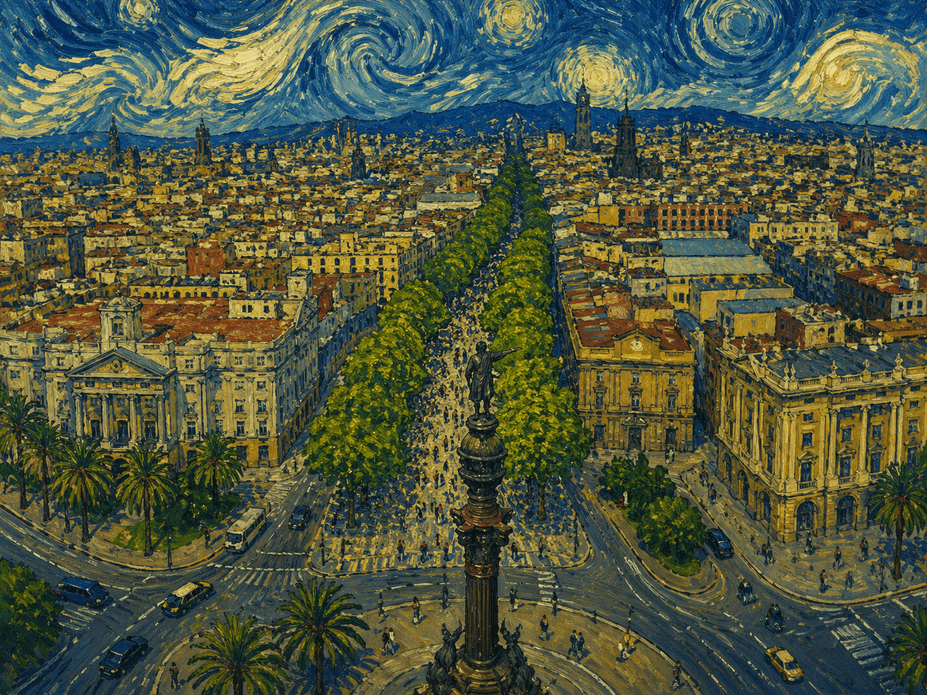
Si quieres recorrer Barcelona a pie en unas horas sin complicarte con transporte, hay una ruta muy sencilla que empieza en el Monumento a Colón y te lleva por lo más interesante del centro histórico. Es un recorrido muy flexible: puedes hacerlo completo o quedarte solo con una parte según el tiempo que tengas.
Antes de empezar, merece la pena subir al mirador del propio monumento. Tiene ascensor y desde arriba se ve bastante bien el puerto, La Rambla y parte del centro. Es un buen punto de partida para orientarse antes de empezar a caminar.
Desde allí, el paseo entra directamente en la ciudad histórica. En pocos minutos llegas a la zona de la Basílica de la Mercè, dedicada a la patrona de Barcelona. Es una parada breve, pero sirve para empezar a notar el cambio de ambiente respecto al puerto.
Siguiendo hacia el Born, el recorrido empieza a ganar interés. Aquí aparece la Santa Maria del Mar, uno de los mejores ejemplos del gótico catalán. Es un edificio que impresiona más por dentro que por fuera, así que si tienes tiempo, merece la pena entrar.
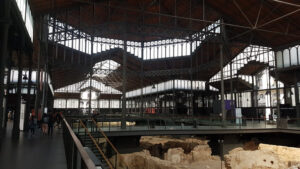
Muy cerca está el Fossar de les Moreres, un espacio pequeño pero con bastante carga histórica, y el antiguo mercado del Born, hoy convertido en centro cultural con restos arqueológicos visibles bajo la estructura. Es una zona donde la ciudad antigua y la actual conviven muy bien.
El Passeig del Born queda justo al lado, y aquí el ritmo cambia: terrazas, movimiento y una sensación más relajada. Es un buen lugar para bajar el ritmo unos minutos antes de seguir.
Desde el Born el recorrido continúa hacia la Plaça de Sant Jaume, donde están el Ayuntamiento y el Palau de la Generalitat. Es el centro político de la ciudad desde hace siglos, aunque muchas veces pasa desapercibido.
A partir de aquí entras en el Barrio Gótico, probablemente la parte más interesante si te gusta caminar sin demasiada planificación.
El Pont del Bisbe es uno de los rincones más fotografiados. A pocos pasos aparece la Plaça del Rei, uno de los conjuntos medievales mejor conservados de la ciudad, y poco después llegas a la Catedral de Barcelona.
Si decides entrar, el claustro es uno de los detalles más curiosos, con ocas en su interior y un ambiente que contrasta mucho con el exterior.
Desde la catedral, el recorrido se abre hacia el Portal de l’Àngel, una de las principales calles comerciales de la ciudad. Aquí el ambiente cambia por completo: más movimiento, tiendas y una sensación más moderna.
Esto te lleva de forma natural a la Plaça de Catalunya, el gran punto de conexión entre el casco antiguo y el Eixample. Aquí el recorrido puede continuar o adaptarse según el tiempo.
Si decides alargar la ruta, lo más lógico es subir por el Passeig de Gràcia. Es una de las avenidas más representativas de Barcelona y aquí aparecen dos de las obras más conocidas de Gaudí: la Casa Batlló y la La Pedrera.
Es una zona más abierta, más elegante y con un ritmo completamente diferente al casco antiguo. Desde aquí puedes volver hacia Plaça Universitat atravesando el Eixample, donde destaca el edificio histórico de la Universidad de Barcelona.
Si prefieres no alargar tanto, desde Plaça de Catalunya puedes ir directamente hacia Plaça Universitat por la calle Pelai, manteniendo la ruta más corta.
Desde Plaça Universitat el recorrido baja de nuevo hacia La Rambla. En la parte alta aparece la Font de Canaletes, un punto muy conocido por la tradición de que quien bebe de su agua vuelve a Barcelona.
A partir de aquí La Rambla se vuelve más evidente: más movimiento, más turismo y un ambiente constante que acompaña todo el descenso.
Siguiendo el paseo aparece el Gran Teatre del Liceu, y justo después, haciendo un pequeño desvío, se llega a la Plaça Reial, una plaza porticada muy agradable, con palmeras y farolas diseñadas por Gaudí.
Volviendo a La Rambla, el recorrido continúa hacia el Palau Güell, una de las primeras obras importantes de Gaudí en la ciudad.
Más abajo aparece el Mercado de la Boqueria, uno de los mercados más conocidos de Europa, y poco después el Palau de la Virreina, donde suelen organizarse exposiciones gratuitas.
En esta misma zona también se encuentra el mosaico de Joan Miró en el suelo de La Rambla, un detalle que pasa desapercibido si no se va atento.
El recorrido termina en las Drassanes Reials, donde hoy se encuentra el Museo Marítimo de Barcelona. Es también una zona donde todavía se conservan restos de la antigua muralla.
Desde aquí puedes volver fácilmente al Monumento a Colón, cerrando el recorrido circular.
Si aún te apetece seguir caminando, el Maremagnum o el paseo hacia La Barceloneta están a pocos minutos y cambian completamente el ambiente hacia zona de mar.
Tiempo aproximado:
- Solo paseo: 2–3 horas
- Con paradas tranquilas: 3–4 horas
- Entrando en sitios: 4–5 horas o más
Es una ruta muy completa porque combina historia, arquitectura, zonas turísticas y ambiente local en un solo recorrido. Además, tiene la ventaja de ser flexible: puedes hacerla entera o solo una parte sin perder coherencia, adaptándola fácilmente al tiempo que tengas.
Aquí tienes una traducción al inglés cortesía de ChatGPT:
English version
Walking Route in Barcelona from Colón: Complete Relaxed Itinerary
If you want to explore Barcelona on foot in a few hours without worrying about transport, there is a very simple route that starts at the Monument to Columbus and takes you through some of the most interesting parts of the historic centre. It’s a very flexible walk: you can do it in full or just follow part of it depending on the time you have.
Before starting, it’s worth going up to the viewpoint inside the monument itself. There is an elevator, and from the top you get a good view over the port, La Rambla, and part of the city centre. It’s a good starting point to get your bearings before you begin walking.
From there, the walk leads directly into the historic city. In just a few minutes you reach the area of the Basilica of La Mercè, dedicated to the patron saint of Barcelona. It’s a short stop, but it already helps you notice the change in atmosphere compared to the port.
Continuing towards El Born, the route becomes more interesting. Here you find Santa Maria del Mar, one of the finest examples of Catalan Gothic architecture. It’s a building that tends to impress more on the inside than the outside, so if you have time, it’s worth going in.
Very close by is the Fossar de les Moreres, a small square with strong historical significance, and the old Born Market, now a cultural centre with archaeological remains visible under the structure. It’s an area where the old and modern city coexist very naturally.
The Passeig del Born is right next to it, and here the pace changes: terraces, movement, and a more relaxed atmosphere. It’s a good place to slow down for a few minutes before continuing.
From El Born, the route continues towards Plaça de Sant Jaume, where the City Hall and the Palau de la Generalitat are located. This has been the political centre of the city for centuries, even if it often goes unnoticed.
From here you enter the Gothic Quarter, probably the most interesting part if you enjoy walking without a strict plan.
The Pont del Bisbe is one of the most photographed corners. Just a few steps away you reach Plaça del Rei, one of the best-preserved medieval complexes in the city, and shortly after that you arrive at the Cathedral of Barcelona.
If you decide to go inside, the cloister is one of the most unusual parts, with geese living there and an atmosphere that contrasts strongly with the exterior.
From the cathedral, the route opens towards Portal de l’Àngel, one of the main shopping streets in the city. The atmosphere changes completely here: more movement, more shops, and a more modern feeling.
This naturally leads you to Plaça de Catalunya, the main connection point between the old city and the Eixample district. From here, the walk can continue or be adapted depending on your time.
If you decide to extend the route, the most logical option is to go up Passeig de Gràcia. It is one of Barcelona’s most iconic avenues, where two of Gaudí’s most famous works appear: the Casa Batlló and the La Pedrera.
This area feels more open, elegant, and completely different in rhythm compared to the old town. From here you can return towards Plaça Universitat crossing the Eixample district, where the historic University of Barcelona building stands out.
If you prefer not to extend the route, from Plaça de Catalunya you can head directly towards Plaça Universitat via Pelai Street, keeping the shorter version of the walk.
From Plaça Universitat, the route goes back down towards La Rambla. At the upper part you’ll find the Font de Canaletes, a well-known spot linked to the tradition that anyone who drinks from it returns to Barcelona.
From here, La Rambla becomes more prominent: more movement, more tourism, and a constant flow of activity along the descent.
Following the street, you reach the Gran Teatre del Liceu, and just after that, with a small detour, you arrive at Plaça Reial, a beautiful arcaded square with palm trees and lampposts designed by Gaudí.
Back on La Rambla, the walk continues towards the Palau Güell, one of Gaudí’s earliest major works in the city.
Further down you find the Boqueria Market, one of the most famous markets in Europe, and shortly after that the Palau de la Virreina, where free exhibitions are often held.
In the same area, you can also spot the Joan Miró mosaic embedded in the pavement of La Rambla, an easy detail to miss if you’re not paying attention.
The route ends at the Drassanes Reials, where the Maritime Museum of Barcelona is located. This area also preserves remains of the old city wall.
From here you can easily return to the Monument to Columbus, completing the circular route.
If you still feel like walking, Maremagnum or the promenade towards Barceloneta are just a few minutes away and completely change the atmosphere into a seaside setting.
Approximate time:
- Just walking: 2–3 hours
- With relaxed stops: 3–4 hours
- Entering sites: 4–5 hours or more
It’s a very complete route because it combines history, architecture, tourist areas, and local atmosphere in a single walk. It also has the advantage of being flexible: you can do it in full or just in parts without losing coherence, easily adapting it to the time you have available.