Si llegas a Barcelona en crucero y solo tienes unas horas para visitar la ciudad, el bus turístico es una de las formas más cómodas de aprovechar el tiempo sin complicarte. No es la opción más local, pero sí probablemente la más eficiente si lo que buscas es ver mucho en poco tiempo sin estar pendiente del metro, las combinaciones o los horarios.
Lo habitual es que el crucero atraque en el Port de Barcelona (Moll Adossat). Desde ahí se toma la lanzadera del puerto, que en unos 10–15 minutos te deja en la zona del monumento a Colón.
A partir de aquí empieza una de las decisiones más prácticas del día: cómo llegar hasta Plaça de Catalunya, que es donde se coge el bus turístico.
Tienes dos formas sencillas de hacerlo.
La primera es la más directa: caminar unos minutos desde Colón hasta el inicio de La Rambla y entrar en la estación de Drassanes (L3, línea verde). Desde allí, en apenas 5–8 minutos de metro, llegas directamente a Plaça de Catalunya. Es la opción más cómoda si no quieres cansarte.
La segunda opción es subir caminando por La Rambla pasando por lugares icónicos como el Liceu, el Mercado de la Boquería o el Palau de la Virreina hasta la Plaça Catalunya. Es un paseo de unos 15–20 minutos que te permite empezar a ver ambiente de ciudad desde el primer momento.
En ambos casos, el resultado es el mismo: acceso rápido al centro sin perder tiempo.
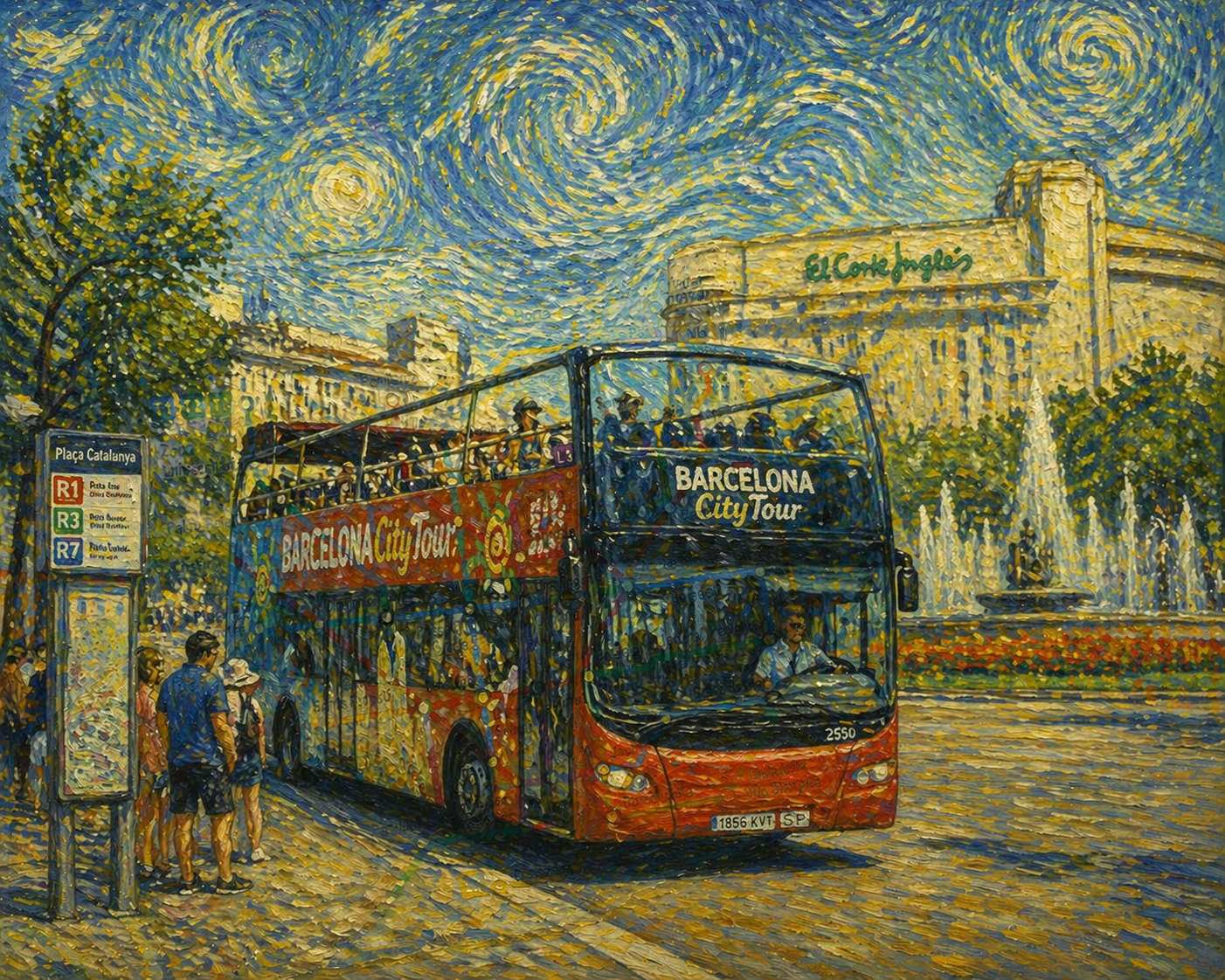
Una vez en Plaça de Catalunya, empieza el recorrido del autobús turístico, un sistema hop-on hop-off que permite subir y bajar libremente en diferentes puntos de la ciudad.
Hay dos compañías que operan autobuses turísticos en Barcelona, y cada una tiene dos rutas principales. Los nombres pueden variar según la empresa, pero en la práctica suelen corresponder a recorridos tipo “Este” o “Sur”.
Si vienes en crucero, lo más útil es priorizar esas rutas (Este o Sur, según la compañía), ya que son las que concentran los puntos más emblemáticos de la ciudad, como el centro, la Sagrada Família y la zona del mar.
El bus turístico comienza pasando por el Passeig de Gràcia, una de las avenidas más elegantes de la ciudad, donde ya se ven algunos de los edificios modernistas más conocidos de Antoni Gaudí, como la Casa Batlló o La Pedrera. Es un tramo corto, de unos 10–15 minutos, pero suficiente para tener una primera impresión clara de la ciudad.
Poco después se llega a la Sagrada Família, que suele ser el punto más importante del día. Aquí mucha gente decide bajar. Incluso solo verla por fuera ya merece la pena, pero si tienes entrada reservada puedes dedicarle bastante más tiempo. En ese caso, cuenta con entre 60 y 90 minutos, lo que condiciona el resto del itinerario.
Desde allí el recorrido continúa hacia el Arc de Triomf, el Parc de la Ciutadella y la zona del frente marítimo. En unos 20–25 minutos de trayecto se llega a la Barceloneta o al Port Olímpic, donde el ambiente cambia completamente y la ciudad se vuelve más relajada.
La Barceloneta suele ser una de las paradas más agradables del día. No hay grandes monumentos, pero sí paseo marítimo, playa y restaurantes, lo que la convierte en un buen punto para descansar entre 20 y 40 minutos antes de seguir el recorrido o volver hacia el centro.
Desde aquí puedes regresar a Plaça de Catalunya o bajar antes en la zona de Colón si quieres acortar el camino hacia el puerto. El trayecto de vuelta suele ser de unos 15 a 25 minutos dependiendo del tráfico.
En total, un día en Barcelona usando el bus turístico en escala de crucero suele ocupar entre 5 y 7 horas, incluyendo traslados, recorrido y paradas.
El billete suele costar alrededor de 30–33 euros para 24 horas e incluye uso ilimitado del bus, las rutas completas y audioguía en varios idiomas.
La clave no es intentar verlo todo, sino elegir bien: centro, Sagrada Família y zona del mar suelen ser los tres puntos que mejor resumen la ciudad en poco tiempo.
Al final, este tipo de itinerario no busca profundizar en Barcelona, sino ofrecer una visión clara, cómoda y sin estrés en el tiempo limitado de una escala de crucero.
Aquí tienes una traducción al inglés cortesía de ChatGPT:
English version
Barcelona in One Day Using the Hop-On Hop-Off Bus from Plaça de Catalunya
If you arrive in Barcelona on a cruise ship and only have a few hours to visit the city, the hop-on hop-off tourist bus is one of the most comfortable ways to make the most of your time without overcomplicating things. It’s not the most local option, but it is probably the most efficient if you want to see a lot in a short time without worrying about metro connections, transfers, or timetables.
Cruise ships usually dock at the Port de Barcelona (Moll Adossat). From there, you take the port shuttle, which in about 10–15 minutes drops you off near the monument to Plaça de Colom.
From here begins one of the most practical decisions of the day: how to get to Plaça de Catalunya, where the tourist bus starts.
You have two simple options.
The first is the most direct: walk a few minutes from Colón to the start of La Rambla and enter the Drassanes metro station (L3, green line). From there, it’s just a 5–8 minute ride directly to Plaça de Catalunya. This is the most convenient option if you don’t want to get tired.
The second option is to walk up La Rambla, passing iconic places such as the Liceu, the Boqueria Market, and the Palau de la Virreina, all the way to Plaça de Catalunya. It’s a 15–20 minute walk that lets you immediately feel the atmosphere of the city from the very beginning.
In both cases, the result is the same: quick access to the city center without wasting time.
Once at Plaça de Catalunya, the tourist bus begins, a hop-on hop-off system that allows you to get on and off freely at different points around the city.
The tourist bus starts by passing along Passeig de Gràcia, one of the city’s most elegant avenues, where you can already see some of Antoni Gaudí’s most famous modernist buildings, such as Casa Batlló and La Pedrera. It’s a short stretch, about 10–15 minutes, but enough to get a clear first impression of the city.
Shortly after, you reach the Sagrada Família, which is usually the main highlight of the day. This is where many people choose to get off. Even just seeing it from the outside is worthwhile, but if you have a reserved ticket, you can spend much more time inside. In that case, expect around 60–90 minutes, which will shape the rest of your itinerary.
From there, the route continues towards Arc de Triomf, Parc de la Ciutadella, and the waterfront area. In about 20–25 minutes of travel, you reach La Barceloneta or Port Olímpic, where the atmosphere changes completely and the city becomes more relaxed.
La Barceloneta is usually one of the most pleasant stops of the day. There are no major monuments, but there is a seafront promenade, beach, and plenty of restaurants, making it a good place to rest for 20–40 minutes before continuing or heading back.
From here, you can return to Plaça de Catalunya or get off earlier near Colón if you want a shorter route back to the port. The return journey usually takes around 15–25 minutes depending on traffic.
In total, a day in Barcelona using the tourist bus during a cruise stop usually takes between 5 and 7 hours, including transfers, sightseeing, and stops.
The ticket typically costs around €30–33 for 24 hours and includes unlimited use of the bus, full routes, and an audio guide in several languages.
The key is not trying to see everything, but choosing well: the city center, Sagrada Família, and the seaside area are usually the three points that best summarize Barcelona in a short time.
In the end, this type of itinerary is not about deeply exploring Barcelona, but about getting a clear, comfortable, and stress-free overview within the limited time of a cruise stop.