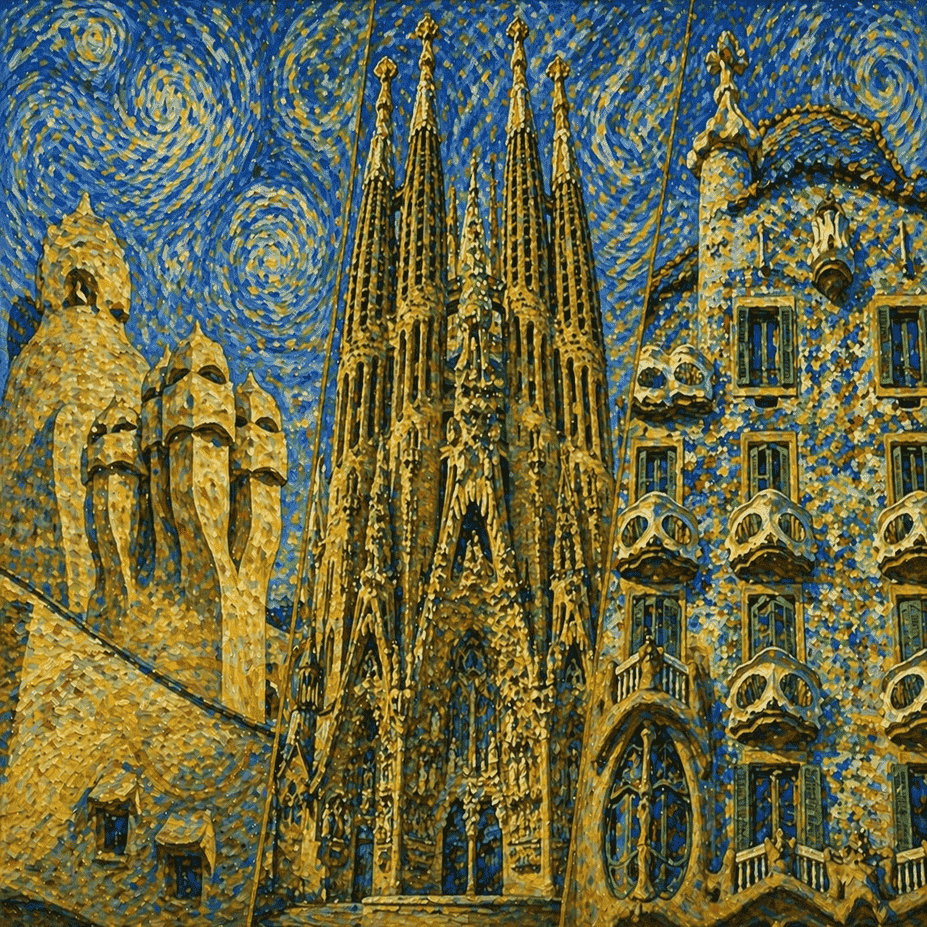
Si te interesa la arquitectura y quieres centrarte en el modernismo catalán, esta es una de las formas más claras de entender el trabajo de Gaudí en Barcelona sin mezclar demasiadas zonas ni perder tiempo en desplazamientos innecesarios.
El punto de partida más lógico es Plaça de Catalunya, que además de ser el gran nodo de transporte de la ciudad conecta directamente con el Eixample y con algunos de los principales ejes modernistas.
Desde aquí puedes ir caminando o en metro hacia Passeig de Gràcia, una de las avenidas más representativas del modernismo en Barcelona. Es un tramo corto, pero interesante porque el trazado del Eixample ya muestra un cambio muy claro respecto al casco antiguo: calles más amplias, ordenadas y con edificios que empiezan a destacar por su arquitectura.
En este punto tomas la línea lila (L2), que te lleva directamente a la Sagrada Família sin necesidad de transbordos. Este es el núcleo de toda la ruta y probablemente la obra más importante de Gaudí.
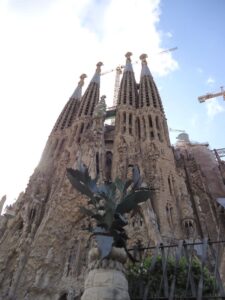
La visita aquí no es solo arquitectónica, sino también estructural y simbólica. El contraste entre fachadas, el nivel de detalle y el hecho de que siga en construcción hacen que sea un lugar único en Europa. Es importante tener en cuenta que, si quieres entrar, necesitas entrada comprada con antelación, ya que no suele haber disponibilidad de última hora.
Después de la Sagrada Família puedes volver hacia el Eixample, normalmente regresando a Passeig de Gràcia. Este tramo es clave porque concentra dos de las obras más conocidas del modernismo catalán: la Casa Batlló y La Pedrera. Es una avenida muy cómoda para caminar y permite ver cómo Gaudí transforma un mismo eje urbano con soluciones arquitectónicas completamente distintas.
Hasta aquí tendrías la parte más representativa del modernismo urbano, pero si quieres ampliar la experiencia, hay una extensión que cambia completamente el contexto.
Si dispones de más tiempo y quieres ver otra faceta del trabajo de Gaudí, puedes añadir el Park Güell al final del recorrido.
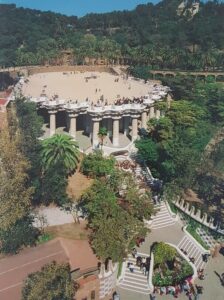
Aquí la arquitectura deja de estar encajada en el tejido urbano del Eixample y pasa a integrarse en un entorno natural elevado, con terrazas, estructuras onduladas y elementos mucho más orgánicos. Es una visión distinta del mismo arquitecto, más libre y ligada al paisaje.
Para llegar, lo habitual es volver hacia el metro desde la zona de Sagrada Família o Passeig de Gràcia y conectar con la línea verde (L3) hasta estaciones como Vallcarca o Lesseps. Desde allí queda un tramo a pie en subida o la opción de combinarlo con bus urbano.
Es importante tener en cuenta que esta parte del recorrido requiere más tiempo, ya que el acceso no es tan directo como en el centro y el terreno es más exigente.
En conjunto, esta ruta permite ver tres caras muy distintas del modernismo de Gaudí en Barcelona: el orden urbano del Eixample, la monumentalidad de la Sagrada Família y la parte más orgánica y paisajística del Park Güell.
Tiempo estimado:
- Ruta base (Eixample + Sagrada Família): 2,5–4 horas
- Con Park Güell añadido: 4–6,5 horas
En conjunto, esta ruta permite ver tres caras muy distintas del modernismo de Gaudí en Barcelona: el orden urbano del Eixample, la monumentalidad de la Sagrada Família y la parte más orgánica y paisajística del Park Güell.
Al final, más que una ruta cerrada, es una forma de entender cómo Gaudí trabaja en contextos completamente distintos dentro de una misma ciudad. Puedes hacerla completa si tienes tiempo o quedarte solo con el eje central del Eixample y la Sagrada Família, que ya por sí solos resumen buena parte del modernismo barcelonés sin necesidad de añadir más desplazamientos.
Aquí tienes una traducción al inglés cortesía de ChatGPT:
English version
Architecture Route in Barcelona: Gaudí, Modernism and Park Güell
If you are interested in architecture and want to focus on Catalan modernism, this is one of the clearest ways to understand Gaudí’s work in Barcelona without mixing too many areas or wasting time on unnecessary transfers.
The most logical starting point is Plaça de Catalunya, which is not only the city’s main transport hub but also connects directly with the Eixample district and some of its most important modernist axes.
From here, you can walk or take the metro towards Passeig de Gràcia, one of the most representative avenues of modernism in Barcelona. It is a short stretch, but an interesting one because the Eixample grid already shows a very clear shift compared to the old town: wider, more ordered streets and buildings that start to stand out for their architecture.
At this point, you take the purple line (L2), which takes you directly to the Sagrada Família without any transfers. This is the core of the entire route and probably Gaudí’s most important work.
The visit here is not only architectural, but also structural and symbolic. The contrast between façades, the level of detail, and the fact that it is still under construction make it a truly unique site in Europe. It is important to keep in mind that if you want to enter, you need to book tickets in advance, as last-minute availability is rare.
After visiting the Sagrada Família, you can return towards the Eixample, usually heading back to Passeig de Gràcia. This section is key because it concentrates two of the most famous works of Catalan modernism: the Casa Batlló and La Pedrera. It is a very comfortable avenue to walk along and clearly shows how Gaudí transforms the same urban axis with completely different architectural solutions.
Up to this point, you would have covered the most representative part of urban modernism, but if you want to expand the experience, there is an extension that completely changes the context.
If you have more time and want to see another side of Gaudí’s work, you can add the Park Güell at the end of the route.
Here, architecture is no longer embedded in the structured urban fabric of the Eixample, but integrated into an elevated natural environment, with terraces, curved structures, and much more organic elements. It is a different vision of the same architect, more free and closely connected to the landscape.
To get there, the usual option is to return to the metro from the Sagrada Família or Passeig de Gràcia area and take the green line (L3) to stations such as Vallcarca or Lesseps. From there, there is a walk uphill or the option to combine it with a local bus.
It is important to note that this part of the route requires more time, as access is less direct than in the city centre and the terrain is more demanding.
Overall, this route allows you to see three very different faces of Gaudí’s modernism in Barcelona: the urban order of the Eixample, the monumentality of the Sagrada Família, and the more organic and landscape-driven side of Park Güell.
Estimated time:
- Basic route (Eixample + Sagrada Família): 2.5–4 hours
- With Park Güell included: 4–6.5 hours
In the end, rather than being a fixed itinerary, this is a way to understand how Gaudí works in completely different contexts within the same city. You can do the full route if you have time, or focus only on the Eixample and Sagrada Família axis, which already captures a large part of Barcelona’s modernist identity without requiring additional travel.